
Rural housing requires not only devolution, but a place-based approach
12 Aug 2026
Andy Burnham’s new UK government could learn from Scotland’s national commitment to a place-based approach, writes Ross Aitchison
With Andy Burnham now in 10 Downing Street, much of the national discourse around place, development and housing has focused on the new government’s future plans to regenerate the UK’s towns and cities.
This is understandable, given the new PM’s political philosophy of ‘Manchesterism’, emerging from his time as metro mayor. What is less clear is how this will apply to, or alleviate, the challenges facing our rural communities.
Being able to access good-quality, climate-resilient, affordable homes is one of the country’s unifying issues. However, in many of our rural areas it is a particularly acute problem, exacerbated by poor connectivity, inconsistent or missing skilled labour forces, ageing populations and small, log-jammed planning authorities. Burnham’s commitment to greater devolution is to be welcomed, but the powers passed down will still be influenced by Westminster, which will maintain control over many of the economic levers needed to fundamentally shift a flatlining economy.

Devolution, not just to towns and cities but also rural areas, can be a beneficial first step in providing the right powers in the right places. If this embeds partnerships, rather than tensions, between national and local governments, devolution can set the framework for a place-centred approach to meeting the challenges of delivering homes in rural areas.
Burnham’s new government could learn from Scotland, where we have a well-established and readily understood national commitment to a place-based approach, with tools such as the Place Standard rooted in development processes. Together with the nascent National Planning Framework 4, this sets a clear commitment for ambitious development which should enhance and strengthen our rural communities.
Despite this, many housing developments being built in rural and semi-rural areas still appear homogenous: uniform in design, scant on amenity, devoid of community. Rural residential schemes that endure go beyond putting a roof over a family’s heads, important though that is.
Successful rural – or peri-urban – housing creates a sense of togetherness, and with it the socio-economic outcomes needed to achieve improved outcomes across health, economy and climate. To achieve this, such developments must adopt a people-first approach from the outset. Housing is a critical first impression of place. It carries a vital role in shaping identity, belonging and resilience for communities.
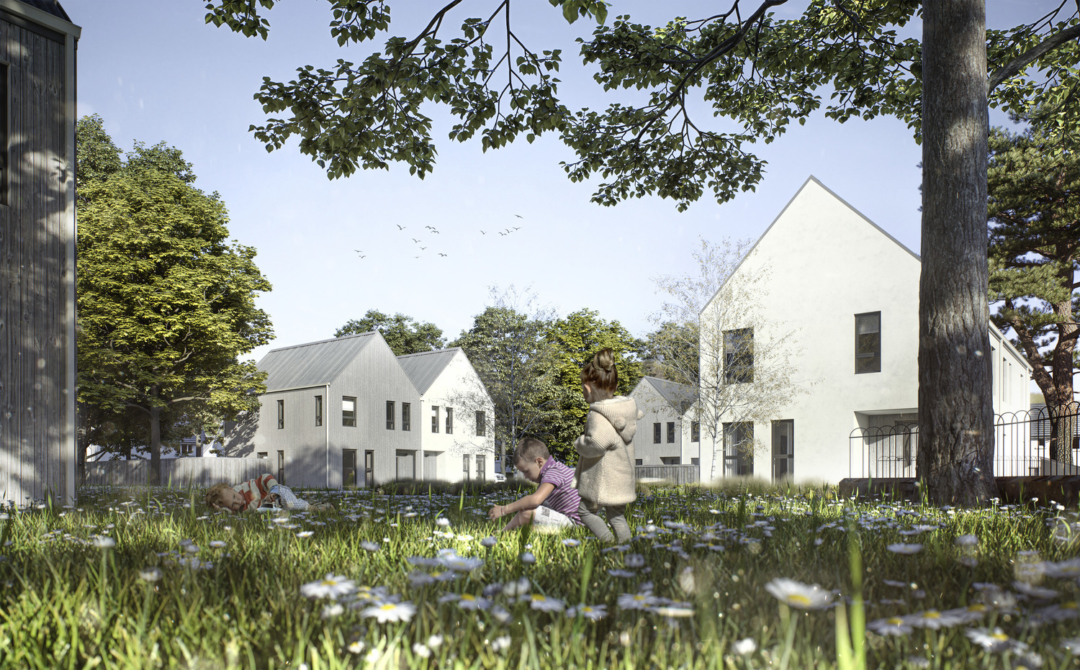
Bilbohall, Collective’s housing scheme on the outskirts of Elgin in north-east Scotland, illustrates how understanding a place demands reading its layered history: planned street patterns, landscape character and the informal development that has grown between the two. The concept design for Bilbohall stepped away from a previously consented standardised market approach to follow these principles. It emerged from a close reading of nearby streetscapes and contemporary rural housing. A ‘people before traffic’ philosophy was applied, with streets designed to encourage and prioritise social interaction over vehicle movement, while materiality decisions – form, proportion, colour – were a direct response to the Scottish agricultural landscape and local vernacular.

Above Image - Dunbeg, by Elder & Cannon Source: Macleod Construction
A similar approach can be seen at Dunbeg near Oban, where Elder & Cannon Architects allowed the site’s undulating terrain, ancient woodlands and protected species to shape the settlement. New neighbourhoods have been connected by extensive tree planting and sustainable drainage designed to maximise local biodiversity, all while addressing the pressing economic and infrastructure needs of a rural Highland community. Both of these schemes are being led not by ‘the market’, but by social housing providers supported by Scottish Government funding, where place quality is regularly prioritised. Such backing is welcome, yet a new national body, More Homes Scotland, seems to be moving us towards greater standardisation of house types and market-based approach, within an already highly regulated planning system.
This has the potential to drive us away from the place-based approach – one delivering the best examples of rural housing – and towards homogenous peri-urban solution which fail to meet the wider socio-economic objectives and outcomes we should all be striving to achieve.
The solution lies in following an ambitious place-based methodology, while making sure we provide the local powers with the right resources and investment to deliver it. If we get housing right, our rural areas will be more resilient, our economy will grow, and the wellbeing of our people and places will be strengthened.
Article by Ross Aitchison - an architect at Collective Architecture